

BMW M1
The Rediscovery of a Legend
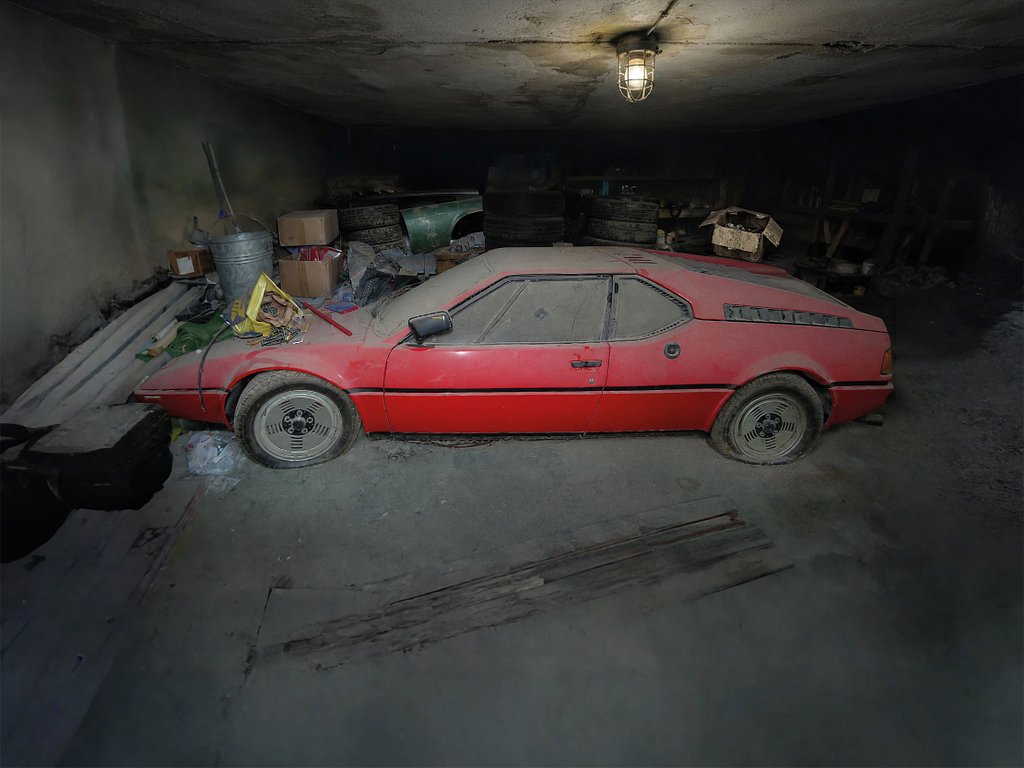
Deep in the back of a large warehouse, hidden behind old inventory and forgotten supplies, a BMW M1 slumbered for decades. Originally acquired by an entrepreneur who later emigrated to Argentina, the car was left behind under a heavy cover. As his children took over the family business, the sports car in the corner lost its relevance, fading into obscurity as the years ticked by. Eventually, soaring market values and nostalgic memories led the owner's son to recall his father's prized German supercar. In cooperation with specialized German engineers and coachbuilders, the long-dormant M1 was carefully brought back to life, honoring the legacy of its original owner and the heritage of the machine itself.
History of the BMW M1
In 1978, BMW introduced its first mid-engine sports car. This BMW icon was penned by the star designer of his era, Giorgetto Giugiaro. BMW commissioned the struggling company Lamborghini to construct parts and build the first M1s. However, lacking quality and unreliability at Lamborghini led to the termination of the joint venture after only a few models.
It was then decided that the Italian specialist Marchesi would manufacture the tubular space frames and T.I.R. the plastic bodywork. Italdesign, having experience with the outgoing Maserati Bora (also a mid-engine sports car), mounted the bodies onto the frames and transported the finished bodies to Baur in Stuttgart. There, the Motorsport GmbH (founded specifically for the M1) delivered the engines, and ZF supplied the drivetrain. Baur then completed this M1—a race car civilized for the street. The midwives of this project were Jochen Neerpasch and BMW engine mastermind Paul Rosche.
Without a doubt, the M1 remains an icon of BMW sports cars to this day, a status certainly cemented by the dedicated BMW Procar series, which took place in 1979 and 1980 ahead of Formula 1 Grands Prix. Famous F1 drivers like Niki Lauda (1979) and Nelson Piquet (1980) each claimed the overall championship. Low, wide, and wedge-shaped were the visual ingredients, while two overhead camshafts, a 3.5-liter 6-cylinder four-valve engine (a sensation at the time) with 277 hp, a 5-speed ZF gearbox, and a mid-engine layout formed the technical ingredients for this BMW legend.
Vehicle Vita and Delivery
This particular BMW M1 was completed on October 11, 1979, and officially delivered to the legendary dealership Automag Buchner + Linse in Munich, Germany.
Regarding the rarity of this specific unit, it is notable for its factory color. Out of the approximately 455 (or roughly 400 to 460) street-legal vehicles built between 1978 and 1981, it is estimated that only about 71 examples were delivered from the factory in red paint. This stands in contrast to the majority of production models which were finished in the more common orange associated with the early release. As one of the few factory-red examples, this vehicle remains a distinct artifact of the limited M1 production run, representing the specialized manufacturing process that defined this brief but impactful era of BMW history.
.
Technical Specifications
-
General Information
-
Year of Manufacture: 1979
-
Body Style: Coupé
-
-
Engine & Performance
-
Cylinders: 6
-
Displacement: 3453 cc
-
Power: 277 hp
-
Top Speed: 262 km/h
-
Acceleration (0-100 km/h): 6 sec
-
-
Transmission & Weight
-
Curb Weight: 1430 kg
-
Transmission: Manual
-
Gears: 5
-